
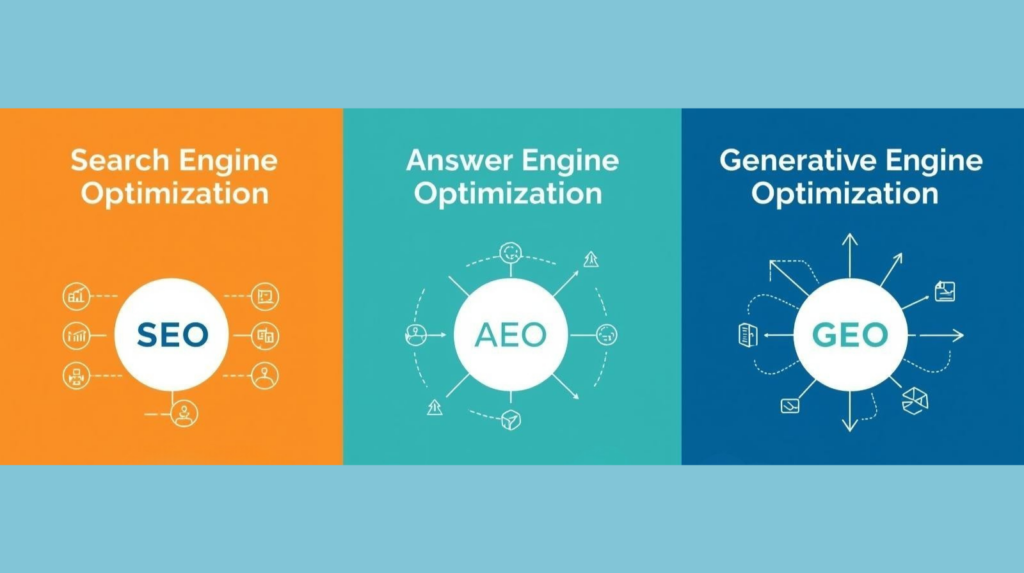
For a long time, “Search” meant typing words into Google and clicking on a blue link. A lot has changed in that area since then. People are now asking voice assistants for quick facts or telling AI tools like ChatGPT to write full summaries.
To stay visible, brands need to stop using just one strategy (SEO) and start using three.
1. SEO (Search Engine Optimization)
The goal is for links to your website to show up on search engine results pages (SERPs) like Bing or Google.
The User Behavior: “I want to see what my options are.” The user types in a question, sees a list of links, and clicks on one to go to a website to find out more.
Organic traffic, clicks, and keyword rankings are all ways to tell if something is working.
2. AEO stands for Answer Engine Optimization
Voice assistants like Siri and Alexa, as well as “zero-click” features like Google’s Featured Snippets, should give you the one and only answer.
The user said, “I want an answer right away.” The user asks a specific question, such as “What is the weather like in Delhi?” and wants an answer right away without having to go to a website.
Position Zero rankings and how easy it is to find the site through voice search are two ways to measure success.
3. GEO (Optimizing the Generative Engine)
Generative AI engines like ChatGPT, Gemini, Perplexity, and Google AI Overviews should be able to use and summarize your work.
The User’s Request: “I want a summary.” The user asks a tough question, like “What are the three best CRM programs for small businesses?” The AI then writes a custom paragraph that sums up the answer and often cites sources.
The success metric is AI responses that mention the brand, citations, and “referral” traffic from AI tools.
Quick Comparison: Feature at a Glance Optimizing Search Engines AEO (Answer) GEO (AI that builds things)
Main Goal Bing and Google Google Snippets, Siri, and Alexa Gemini, ChatGPT, and Perplexity BlueSpoken Words or Short Text Summaries and Combined Information with Links and Webpages
Important Plan: Backlinks and keywords Q&A Markup Format and Schema: Facts, citations, and authority
Style of Content: Full-length and detailed; short and to the point (40–60 words) One-of-a-kind, full of data, and trustworthy
Putting the plan into action: How to win all three
You don’t need three teams to do this. If you set it up right, a unified content strategy can work for all three engines.
Step 1: The Base (SEO)
How healthy is the technology? Check that your site loads quickly and works well on phones and tablets. If a bot can’t crawl your site, Google and ChatGPT won’t be able to read it.
Keyword research: Learn what your customers want.
Strategy: Write content that is well-written, focused on people, and covers the topic in depth.
Step 2: The AEO, or Answer Layer
The “FAQ” Strategy says that every piece of content should answer some questions.
AI has trouble reading long pieces of text. Use bullet points, bold text, and numbered lists to make answers stand out.
The 40-Word Rule says that in the first 40 to 60 words of the section, you should give a direct, factual answer to each main question before going into more detail. This is what voice assistants will say.
Step 3: The GEO Authority Layer
Tell the AI things: Generative AI puts a lot of weight on “facts” and “authority.” It wants to use quotes from experts.
Original Data: Share original statistics, case studies, or expert quotes. AI models like data that is not already available to them.
Citations: Be sure to clearly cite your sources in your writing. This tells the AI that your content is trustworthy and well-researched.
Step-by-Step Guide to Putting It into Action
To make sure that every new piece of content works well for SEO, AEO, and GEO at the same time, follow this workflow.
Step 1: Use “intent” headers to sort
Use a specific question like “What are the benefits of X?” instead of a general title like “Benefits.”
Why: This is for AEO (people who use voice search ask questions).
Step 2: Complete the “Direct Answer” section
After the header, write a short summary of two to three sentences (about 50 words) that directly answers the question. Don’t be silly.
Why: This wins Featured Snippets (AEO) and gives AI a clear summary to grab (GEO).
Put in the “Deep Dive” in Step 3
Include more information after the direct answer, such as examples, paragraphs, and background information. Use keywords in a way that makes sense.
Why: This shows how deep and important it is for SEO rankings.
Step 4: Improve it by adding data and schema.
Include a quote from an expert, a number, or a table that shows how things are different. Then, only use Schema Markup (code that helps bots understand your content) for “How-To” or FAQ sections.
Why: AI (GEO) uses structured data as its language.
Step 5: Share to Increase Your Brand’s Authority
Talk about your brand on other trusted sites, like PR and guest posts.
Why it is important: AI models figure out which brands are trustworthy by looking at how often people talk about them online. If you are mentioned a lot (GEO), AI is more likely to suggest you.