
The Omnicom-IPG Merger, Algorithmic Disruption, and the Future of Traditional Advertising
Key Takeaway: Media companies are not going out of business, but they are changing a lot. The $13.5 billion merger of Omnicom and IPG is a sign of how AI is changing the industry. It is forcing agencies to stop charging by the hour and start charging based on results. Sir Martin Sorrell says that in two to three years, algorithmic media buying will take over and put thousands of traditional media planners out of work. The industry is still growing (it will be worth $1.14 trillion by 2025), but AI-first models are changing the way companies compete. AI-first platforms, internal marketing teams, and small agencies are all using them. Agencies that don’t adapt will go out of business, but those that shift their focus to strategy, data orchestration, and AI will do well.
The Great Consolidation: Omnicom buys IPG for $13.5 billion
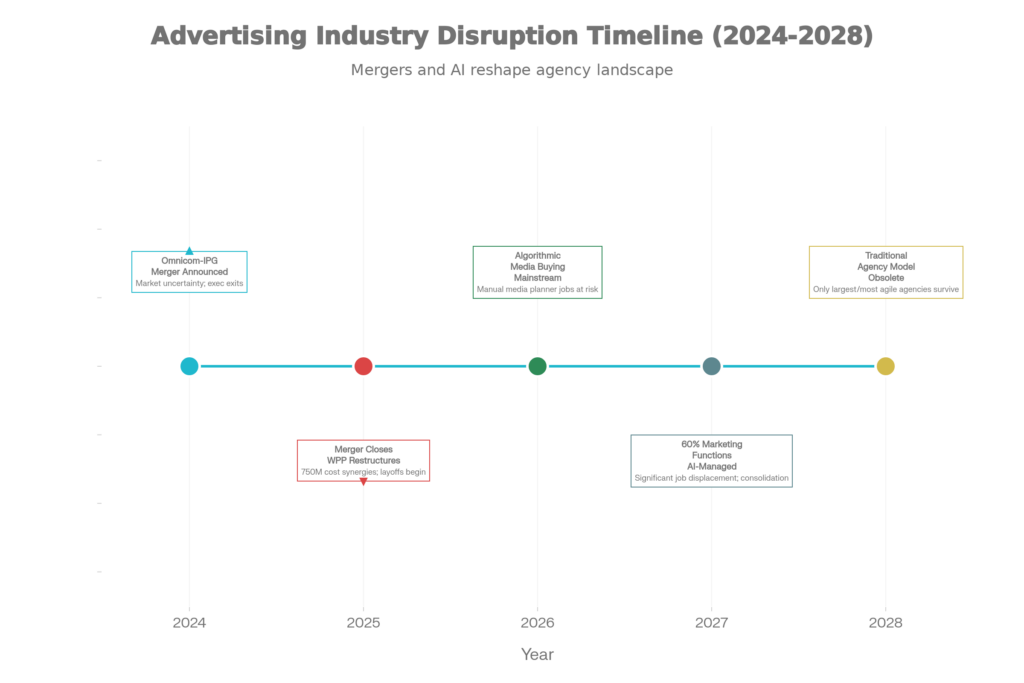
Omnicom Group said in December 2024 that it would buy Interpublic Group (IPG) for $13.5 billion. This would make it the world’s largest advertising network by revenue. This was one of the biggest changes in the world of advertising. The official end of this big merger was on November 26, 2025. It changed how businesses compete and showed how old agencies are dealing with AI disruption by merging instead of coming up with new ideas on their own.
The terms of the deal and the reasons for it show that the industry is worried about more than just the deal itself. As part of the merger, IPG shareholders got 0.344 shares of Omnicom common stock for every share of IPG stock they owned. When the deal is done, Omnicom shareholders will own 60.6% of the new company, and IPG shareholders will own 39.4% of it, fully diluted. The new company is expected to make more than $25 billion in pro forma revenue every year and hire more than 100,000 people around the world. This puts it ahead of competitors like Publicis Groupe and WPP.
The promised synergies show how bad the industry’s finances are. Omnicom and IPG’s top executives said they expected to save about $750 million a year by merging. This means that a lot of people would lose their jobs and the two companies would become one. Both companies want to cut costs, which means they expect to run with fewer employees and leaner structures, even though the merger will make the biggest agency network in the world. The merger’s focus on data-driven marketing, precise targeting, and technology integration shows that a company’s size is now based on how well it can use algorithms, not how creative it is.
Regulators in big markets like China, Colombia, Brazil, Saudi Arabia, Egypt, and India had given their approval to the deal by the middle of 2025. But this fast approval process made a lot of people in the industry doubt it. Pitch consultants said that not knowing which stores would be combined, how talent rosters would change, and how current clients would be served could make ongoing agency reviews less stable. The merger made the company weak right away, and during the transition period, competitors started stealing clients and talent.
Sir Martin Sorrell’s Prophetic Warning: The End of Planning for Traditional Media
Sir Martin Sorrell, who founded WPP and is now the executive chairman of S4 Capital, is the most important person in the advertising industry to talk about what AI really threatens: the jobs of people who plan and buy traditional media. His comments are more than what people in the industry usually say, and they are a strong criticism of how the traditional agency model can work in a world where AI is becoming more and more important.
Sorrell’s most shocking prediction is clear: “Media buying and planning will become mostly algorithmic and automated within the next two to three years.” This is not just a guess; it is Sorrell’s opinion based on his decades of experience building WPP into the world’s largest agency group and his current work at S4 Capital, where he has made the company a leader in algorithmic media buying.
The effects are very big. Hundreds of thousands of people work for agencies all over the world to plan and buy media. These jobs used to pay agencies a lot of money, and media planners used to get good pay and benefits. Sorrell’s main point, though, is that “you will not rely on a 25-year-old media planner; you will rely on an algorithm.” This change is already happening. Sorrell said at CES 2025 that “agencies are validators,” but they now have to prove their worth in a world where algorithms and AI-driven platforms are in charge.
Sorrell talked about the important issue of whether AI stifles creativity. He said, “No, it makes it better.” Strategic and creative thinking are still important, but now we use data and technology to do things faster and better. This is an important point because it shows that the real loss of value is not in creativity itself, but in the ability to carry out campaigns and the work that goes into them.
Sorrell’s ideas are more than just about planning media. He believes that “ideation teams will use technology like Sora or Lightricks where text or voice is instantly converted into video.” This video will then be turned into a plan and a purchase that an algorithm can use. This end-to-end AI orchestration cuts out the steps in the middle—concept approval, production coordination, media brief development, and placement execution—that agencies usually charge for.
The most important thing Sorrell says is that the economics of advertising will change a lot. He said that many advertisers spend more than 10% of their media costs on creative work, which is more than the 15% that agencies used to charge for both creative and media. He said, “With AI, that ratio should go down a lot, especially in a world with slower growth, higher costs, and fewer opportunities.” This means that clients will want huge fee cuts as AI takes over planning and production.
AI’s Threat to Real-World Business Models in Agencies
The issues faced by media agencies are not transient; they are enduring. AI has fundamentally challenged every revenue pillar of the traditional agency model.
The Automation of Creative Work
Anyone can now make creative content thanks to generative AI tools like OpenAI’s ChatGPT, Midjourney, Adobe Firefly, and Google Gemini. In the past, it took teams of copywriters, graphic designers, video editors, and creative directors hours to do what can now be done in minutes. This is a big boost in efficiency. One report from an agency said that when AI workflows took the place of traditional production, costs went down by 85% and campaign turnarounds went down by 70%.
Right now, there is a lot of pressure to compete. 78% of marketers believe that at least 25% of their work will be done by computers in the next three years. More than a third of people think that AI will do more than half of their work. IDC says that by 2028, AI systems will do 60% of marketing work, and businesses will spend up to three times as much on AI optimization as they do on regular search engines.
But agencies are in a weird spot: clients want to pay less because AI makes production faster and cheaper. Using AI to make assets has made production faster and cheaper for agencies, but this hasn’t lowered agency fees by the same amount. “We’re asking them to give us more assets or pass on production savings,” said a customer of XYXX Apparels. “If AI cuts the time it takes to create designs or manage media by 25%, it’s not unreasonable or unfair to expect fees to go down by 25%.”
The End of Billing by the Hour
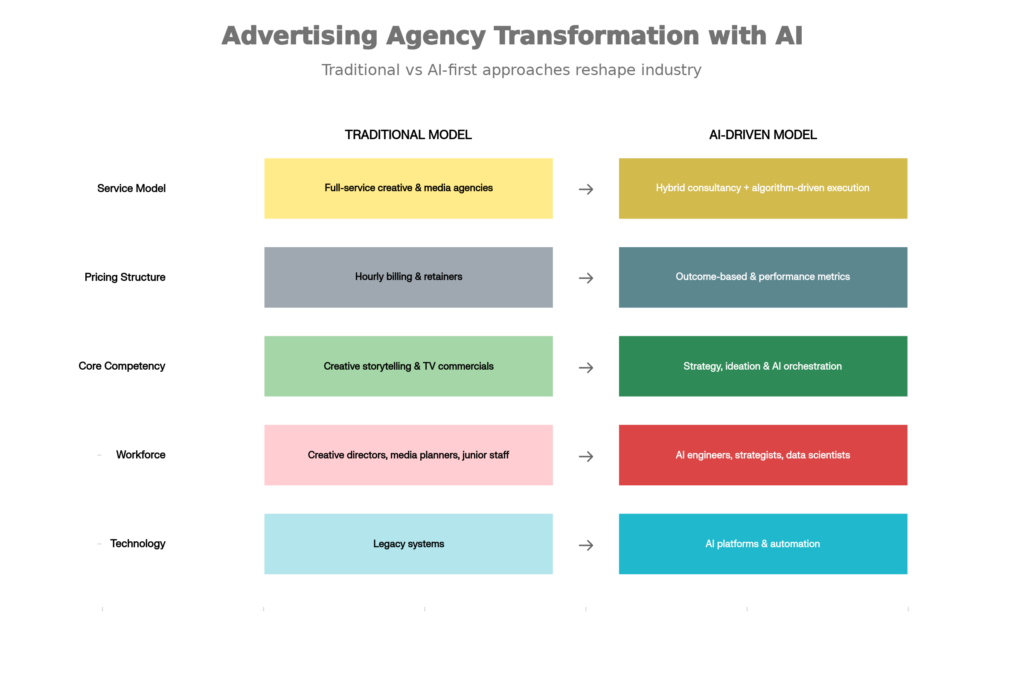
Billable hours are the basis of the traditional economic model for agencies. Every designer, strategist, producer, and planner keeps track of how long they work on client accounts. The agency’s income comes from multiplying the total hours worked by the rates charged. But AI ruins this model by making delivery times much shorter while keeping (or even improving) the quality of the work.
Big holding companies have begun to switch their retainers from charging by the hour to paying based on results and performance. This change is especially hard for agencies that do things like lead generation, SEO traffic, and conversion optimization, where they can see how well they are doing. But this change makes margins much smaller than they were with the hours-based model, because agencies now have to show direct business impact instead of just effort.
The most forward-thinking agencies are trying out usage-based, token-metered models, performance-based pricing based on KPIs, and hybrid structures that combine retainers with incentives based on results. But these models still don’t make as much money as traditional retainers because agencies can’t charge as much for billable hours anymore.
Clients and platforms are in direct competition with each other.
Agencies’ own clients may be the biggest threat to them, not other agencies. Internal marketing teams can now use AI platforms to plan, launch, and improve campaigns in real time. The big question is: What does an agency do when a marketing team can run campaigns on their own with ChatGPT, Midjourney, and programmatic advertising platforms?
Google’s Performance Max, Meta’s Advantage+, and Amazon’s advertising network are all tech platforms that let customers run their own campaigns and get reports on how well they are doing and how to improve them in real time. As these platforms get better at explaining results to clients with fewer agency people needed, the traditional agency role as a middleman and validator fades away.
The Pricing Crisis: Companies Want 25% Off Their Fees
One of the clearest signs that agencies are in trouble is the current pricing crisis. Brands are actively asking agencies to lower their fees by 25% or more while also doing more work as of December 2025. This isn’t a way to get what you want; it’s just how AI has changed the economy.
It’s easy to understand: “If AI cuts the time it takes to make designs or manage media by 25%, it’s not unreasonable or unfair to expect fees to go down by 25%.” Brands are basically asking agencies to pass on the productivity gains that AI makes possible instead of keeping them as profit.
This pressure on prices is causing the agency world to split in two. Big agencies say they are using the money they save from AI to make campaigns bigger instead of lowering their fees. Smaller, more adaptable stores, on the other hand, are trying to shake things up. One executive from an agency said, “For smaller shops, the chance is huge. Imagine turning a whole creative team into a five-person strike squad with supercomputers.”
But this change also shows a big problem: if an agency’s main selling point is that it can run campaigns faster and cheaper with AI, then it is no longer offering a unique service. If a competitor has the same AI tools, they can copy the work, which makes it hard to tell the difference and lowers prices.
The Great Restructuring: Losing Jobs and Merging Industries
The merger between Omnicom and IPG is part of a larger trend of agencies merging, but it also hides a more worrying truth: the industry is merging not to get more market share, but to cut costs and eliminate duplication.
People are already losing their jobs because of mergers. The merger between Omnicom and IPG is expected to save $750 million, but it will also mean the loss of thousands of jobs. We still don’t know which agency brands will be combined, how the talent lists will be changed, or if client conflicts will force spinoffs.
This disruption is made worse by bigger trends in the business. The holding-company structure, which has long been thought to give WPP more buying power in the media, is no longer useful. This is shown by WPP’s decision in May 2025 to get rid of GroupM and start WPP Media. Now, WPP is putting all of its media agencies—Mindshare, Wavemaker, EssenceMediacom, and Essence—together into one profit center. This means getting rid of CEOs and levels of management and putting all the decisions about AI, data, and technology in one place.
This restructuring proves what industry leaders have been saying quietly: the old way of having a holding company with several competing agency brands to get bigger doesn’t work anymore. Instead, companies are moving toward unified structures where all of their AI infrastructure, data management, and decision-making are in one place.
The Cost to People
The job market is getting worse very fast. Anthropic’s CEO, Dario Amodei, said that AI could take away half of all entry-level white-collar jobs in the next five years. This could cause the U.S. unemployment rate to rise to 10% to 20%. Some economists don’t think AI is the main reason for job losses. Instead, they point to macroeconomic factors like inflation and interest rates. But the proof is clear in the fields of marketing and creativity.
One person who used to work at an ad agency said, “A staggering 75% of my creative team was let go because of the rise of AI. Tools like Stable Diffusion and ChatGPT were first presented as improvements, but they quickly became replacements. We found ourselves replacing writers, editors, animators, actors, graphic designers, and illustrators with AI technologies.”
What Agencies Still Have: Why They Should Stay Alive and Change
Even though the agency industry is having a lot of trouble, it won’t go away. There are many reasons to think that agencies that are open-minded and adaptable will not only survive but also thrive.
Making Strategic Value
Sorrell says that agencies can still be useful by focusing on what people are good at, like making plans, understanding customers, and positioning brands. Agencies that will last will be the ones that use AI to get things done faster while still focusing on strategy, creative direction, and how it will affect the business.
This is where smaller, more focused agencies are getting their break. An executive at a small agency said, “AI can make a hundred different versions in seconds, but it still can’t sense a cultural moment or create emotional tension.” This shows that they have a real competitive edge: it’s still hard to automate human intuition about culture, consumer sentiment, and creative resonance.
Why Data and First-Party Insights Are Important
By focusing on data assets, precision marketing, and combining commerce, both Omnicom and IPG are making the merged company stronger. Big media buyers are betting on data advantage as a key way to stay ahead of the competition. For example, they bought Acxiom (IPG’s data unit) and Intelligence Node (an eCommerce intelligence platform).
First-party data will become more and more valuable as third-party data becomes less reliable because of privacy laws. Agencies that can collect, organize, and use first-party data from different client systems will have a big advantage over their competitors. This skill is hard for internal marketing teams that work alone to develop, and it needs advanced infrastructure that works across departments.
The Omnicom Model: Getting Ahead by Using Size
The goal of the merger between Omnicom and IPG is to give the company an edge in buying media, especially for connected TV and streaming. The merged company has enough media spending power across its portfolio to be able to negotiate with tech platforms like Google, Meta, and Amazon from a strong position.
This suggests that the future will be divided into two parts: a few large agencies that can work with platforms and have access to proprietary AI infrastructure, and a long tail of small, specialized agencies that serve niche markets. The middle, which is made up of mid-sized generalist agencies, is going through a lot of stress.
Putting the focus on results
The best agencies are changing what they offer clients from deliverables or effort to business results. Agencies need to know how to measure business performance, understand their clients’ finances, and pay their employees based on results instead of hours worked or assets delivered.
Agencies that focus on craft, strategic intelligence, and real creative impact might actually do better because of AI. The main difference is whether the agency’s main value is getting things done quickly (which AI could do) or coming up with strategies and getting results (which automation couldn’t do).
The Big Picture: Growth in the Face of Change
It’s odd that the advertising industry is still growing even though traditional agencies are having a lot of trouble. In 2025, global advertising revenue reached $1.14 trillion, an 8.8% rise (not including political ads in the U.S.). WPP says that growth will be 7.1% in 2026 and 6.3% over the next five years.
But this growth hides big changes in some areas. By 2025, advertising for businesses is expected to reach $178.2 billion. This will be the first time it has ever been bigger than advertising on TV around the world. The gaming industry has grown by 29.5% to $8.5 billion. At the same time, linear TV is losing viewers to streaming, and traditional TV ads are losing 10–15% of their viewers every year.
The AI marketing industry is growing quickly, with a value of $47.32 billion in 2025 and a projected value of more than $107.5 billion by 2028. The growth rate is 36.6% per year. This is the part of marketing and advertising that is growing the fastest, and it’s not just because of money from traditional agencies. It’s not because of the SaaS platforms, ad-tech companies, or the money that clients put in themselves.
Conclusion: The Agency Model Is Evolving, Not Disappearing
The data shows that the conclusion is more complicated than just saying “agencies are dying.” Instead, the traditional agency model is going through a major change that will destroy a lot of value for some companies while creating new chances for others.
Full-service agencies that still use TV ads, charge by the hour, and keep creative media separate are going out of business. The fact that Omnicom and IPG are merging shows that the only way for old companies to stay in business is to buy and merge with other companies.
But agencies that have shifted their focus to AI augmentation, outcome-based pay, strategic consulting, and data-driven personalization are becoming more important again. It seems that the secret to staying alive is to use AI to make things run more smoothly, human creativity to give things meaning, and strategic consulting to make a difference in business.
Sir Martin Sorrell’s guess that algorithmic media buying will be the norm in two to three years is probably right. But this doesn’t make an agency less valuable; it just makes us think about it differently. Agencies will go from running campaigns to managing AI systems, checking the choices made by algorithms, and giving businesses strategic advice to make sure that technology helps them reach their goals.
The advertising market, which is worth $1.14 trillion, will keep growing. But instead of going to traditional agencies, the money will go to platforms, in-house teams with AI tools, and a smaller number of mega-agencies that have their own data, AI infrastructure, and consulting skills.
The next two to three years will be very important for the thousands of people who work at traditional agencies as media planners, junior creatives, and operations staff. Agencies that spend a lot of money on AI experts, data skills, and new business models that work may do well. People who stick to old ways will see their businesses fail. The whole industry will have changed from a consulting model based on hours to a technology-driven, outcomes-driven ecosystem where human creativity and machine efficiency come together to make marketing value.