B2B vs B2C Marketing Strategy: The Practical Guide
B2B and B2C marketing differ less in tactics than in decision structure. Here are the rupee maths, channel price bands and failure modes for each.
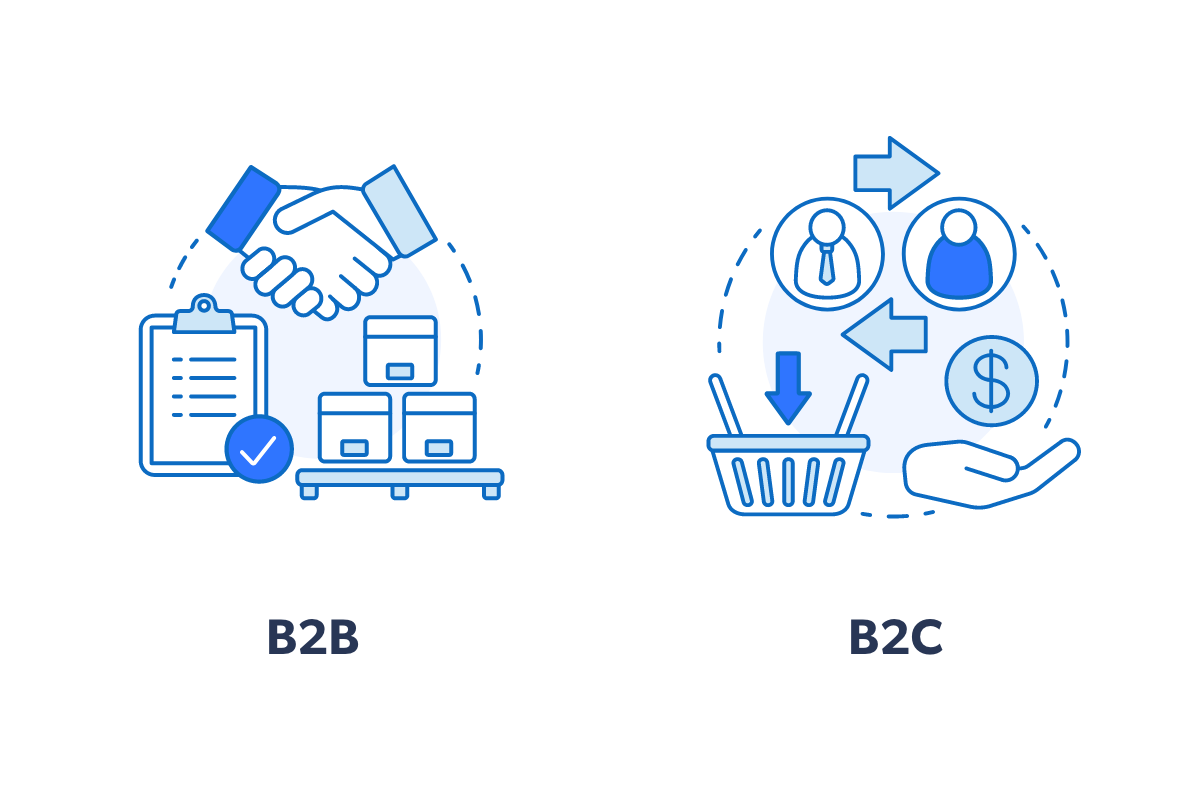
The real difference between B2B (business-to-business) and B2C (business-to-consumer) marketing is not the creative, the channels or the tone — it is the decision structure. B2B sells to a group of people who must agree with each other over weeks or months, so the strategy is built around nurturing a small, identifiable audience and proving low risk. B2C sells to one person deciding largely for themselves in minutes or days, so the strategy is built around reach, speed to purchase and repeat buying economics.
Everything else — budget split, channel choice, how you measure, how long you wait before judging a campaign — falls out of that one difference. This guide walks through it with the arithmetic shown in rupees, India price bands as of September 2026, and the failure modes that actually sink campaigns.
What B2B and B2C mean in practice
B2B means a company sells to another company. AWS selling cloud infrastructure to a bank, Freshworks selling helpdesk software to a logistics firm, or a packaging manufacturer selling cartons to a food brand are all B2B.
B2C means a company sells to an individual buying for themselves or their household. Zara selling a jacket, Zomato selling a food delivery order, or a D2C (direct-to-consumer) skincare brand selling a serum on its own website are all B2C.
Plenty of businesses are both. A bank sells current accounts to companies and savings accounts to individuals. Google sells Workspace to enterprises and YouTube Premium to consumers. When that happens, you do not run one strategy — you run two, with different budgets, different measurement windows and usually different people owning them.
B2B vs B2C at a glance
| Dimension | B2B | B2C |
|---|---|---|
| Who decides | A buying group — commonly cited research puts it at roughly six to ten people | One person, sometimes influenced by family or peers |
| Typical cycle | 3 months to 18 months | Minutes to a few weeks |
| Addressable audience | Hundreds to low thousands of accounts | Hundreds of thousands to tens of millions of people |
| Deal value | High — lakhs to crores | Low — hundreds to a few thousand rupees |
| Core risk being managed | Career risk: “will this make me look bad?” | Personal risk: “will I waste ₹1,500 and my time?” |
| Data volume for testing | Tiny — single-digit deals per month | Large — hundreds or thousands of orders per month |
| What success looks like at 30 days | Pipeline created, meetings booked | Revenue, contribution margin, repeat rate |
| Main failure mode | Judging a 9-month cycle on 30-day data | Buying unprofitable first orders and calling it growth |
Difference 1: you are marketing to a committee, not a person
In B2B, the person who downloads your guide is rarely the person who signs the cheque. A typical enterprise software purchase involves an end user who feels the pain, a manager who scopes the requirement, an IT or security reviewer, a finance approver and often a procurement team that exists purely to negotiate your price down.
That has a direct planning consequence: one message will not work. The practitioner wants to know it will not break their workflow. The CFO wants the payback period. Security wants your data residency policy. If your entire campaign is one product-benefit ad pointed at job titles, you are talking to one member of a group of eight.
The practical fix is to build an ICP (ideal customer profile) — a written definition of the companies worth selling to, by industry, size, tech stack and trigger event — and then list the three to five roles inside that account you need to reach. Budget and creative get planned per role, not per channel.
In B2C the picture inverts. You are reaching one decision-maker, but you need to reach a very large number of them, which makes cost per thousand impressions, creative volume and landing page speed the levers that matter most.
Difference 2: the sales cycle rewrites your budget maths
A nine-month B2B cycle means money you spend in September shows up as revenue in June. A three-day B2C cycle means money you spend on Tuesday shows up as revenue on Friday.
So B2B budgets have to be committed on faith for at least two quarters before the first honest read is available, and B2B marketers should report pipeline created as the primary monthly number, with closed revenue reported on a lag. B2C budgets can be adjusted weekly, which is a gift — and a trap, because weekly adjustment tempts teams to over-react to noise.
If you are splitting a fixed annual budget across proven and experimental work, the logic in our guide to the 70-20-10 marketing budget rule applies to both, but the review cadence does not: review B2B allocations quarterly, B2C allocations monthly.
Worked example: a B2B SaaS funnel in rupees
Assume a software company selling a ₹6,00,000 annual contract, spending ₹5,00,000 a month on LinkedIn and Google Search.
- ₹5,00,000 spend ÷ ₹180 average CPC (cost per click) = 2,777 clicks
- 2,777 clicks × 6% landing page conversion = 166 raw leads
- 166 × 40% that fit the ICP = 66 MQLs (marketing qualified leads)
- 66 × 15% accepted by sales = 10 SQLs (sales qualified leads)
- 10 × 20% close rate = 2 deals
Media CAC (customer acquisition cost) = ₹5,00,000 ÷ 2 = ₹2,50,000 per customer. Now add the sales team: one account executive plus one SDR (sales development rep) at roughly ₹4,00,000 a month fully loaded is another ₹2,00,000 per deal. Fully loaded CAC = ₹4,50,000.
Is that good? Take 80% gross margin and average retention of three years: lifetime gross profit = ₹6,00,000 × 3 × 0.80 = ₹14,40,000. That is an LTV:CAC ratio of 3.2:1, and CAC payback of ₹4,50,000 ÷ ₹4,80,000 annual gross profit × 12 = about 11 months. Both are healthy. Both are also invisible until nearly a year of data exists.
Worked example: a D2C brand funnel in rupees
Now a skincare brand with a ₹1,200 average order value, spending ₹3,00,000 a month on Meta.
- ₹3,00,000 at a ₹220 CPM (cost per thousand impressions) = 13.6 lakh impressions
- × 1.1% click-through rate = 15,000 clicks (an effective CPC of ₹20)
- × 1.6% site conversion = 240 orders
CAC = ₹3,00,000 ÷ 240 = ₹1,250. Contribution per order at 55% gross margin is ₹660, less about ₹150 for shipping, COD (cash on delivery) handling and returns, leaving ₹510.
So the first order loses ₹740. The brand only survives on repeats: at 2.5 orders per customer in twelve months, contribution is 2.5 × ₹510 = ₹1,275 against a ₹1,250 CAC. That is a ₹25 profit per customer after a full year — a business balanced on a knife edge, and one where a 10% rise in CPM wipes out the margin entirely. If you have not modelled this for your own brand, start with our walkthrough on calculating customer lifetime value in a spreadsheet.
What those two examples actually prove
Look at the sample sizes. The B2B business closed 2 deals in a month. The D2C brand shipped 240 orders.
A standard sample-size calculation says that detecting a lift from 1.6% to 2.0% conversion with reasonable confidence needs roughly 9,000–10,000 sessions per variant. The D2C brand reaches that in about six weeks. The B2B company will never reach it on closed deals — not in a decade.
This is why the two disciplines measure differently, and why copying B2C measurement practice into B2B is the single most common strategic error in the field:
- B2C can run genuine A/B tests on creative, landing pages and offers, and should.
- B2B must rely on leading indicators (meetings booked, opportunity creation, win-rate by segment), qualitative win/loss interviews, and geo or account holdout tests rather than per-click attribution.
Both, once spend is large enough, benefit from stepping back from click attribution entirely. Our explainer on MMM vs attribution vs incrementality testing covers when each method earns its keep.
Choosing channels: India price bands, September 2026
Plan audience first, channel second. But you still need a sense of what things cost. The figures below are estimated ranges observed in the Indian market, not published rate cards — actual costs swing widely with targeting, category competition and creative quality. Treat them as a sanity check on a media plan, not a quote.
| Channel | Typical India cost band (estimate) | Fits | Watch out for |
|---|---|---|---|
| LinkedIn Ads | ₹90–₹300 CPC; ₹400–₹900 CPM | B2B, senior titles, ABM | Cheapest clicks often come from the least senior audience |
| Google Search — B2B software intent | ₹120–₹600 CPC | B2B, bottom of funnel | Competitor bidding inflates costs fast |
| Google Search — consumer product | ₹8–₹45 CPC | B2C, high purchase intent | Brand terms flattering your reported ROAS |
| Meta Feed and Reels | ₹80–₹280 CPM | B2C scale, D2C prospecting | Creative fatigue within 10–14 days |
| YouTube skippable in-stream | ₹0.30–₹1.50 per view | Both — awareness and demos | Views are not attention; check watch-through |
| WhatsApp marketing message | ~₹0.70–₹0.90 per message plus provider markup | B2C retention, B2B renewals | Opt-out spikes if frequency is not capped |
| Programmatic open exchange display | ₹40–₹150 CPM | B2C reach, B2B retargeting | Inventory quality; insist on placement reports |
| Industry event or conference booth | ₹2,00,000–₹25,00,000 per event | B2B, enterprise deals | Costs nothing to attend, everything to follow up badly |
Two India-specific notes. First, WhatsApp is now a mainstream marketing channel here, not a support tool — Meta charges per message through a BSP (business solution provider), so frequency discipline is a budget decision, not just a courtesy one; our WhatsApp marketing playbook covers the mechanics. Second, if you are choosing between the two biggest paid platforms for a consumer brand, the trade-off is laid out in Meta Ads vs Google Ads for Indian D2C brands.
Messaging: the “logic vs emotion” split is mostly wrong
The old rule says B2B buyers are rational and B2C buyers are emotional. That is not what happens in the room.
B2B buyers are intensely emotional — about risk. A VP choosing a vendor is asking whether this decision could damage their standing if it goes wrong. That is fear, dressed in a business case. Which is why case studies from recognisable peer companies, security documentation and a credible implementation timeline out-perform feature lists.
B2C buyers, meanwhile, do plenty of rational work: comparing prices across three tabs, reading reviews, checking the return policy. Nobody spends ₹4,000 on a purely emotional impulse without checking whether they can send it back.
The more useful distinction is this: B2B messaging must reduce perceived risk; B2C messaging must reduce perceived friction. Everything you write should be tested against that. A B2B page adds a security page and named references. A B2C page adds free returns, a UPI payment option and a two-step checkout.
Where B2B and B2C have converged
Three shifts have narrowed the gap and are worth building into a 2026 plan.
Self-serve B2B. Many software products now let a team swipe a corporate card for a small plan before any salesperson is involved. That part of a B2B business behaves exactly like B2C and should be measured that way — conversion rate, activation, payback — while enterprise deals stay on the long-cycle model.
Buying research happens off your site. Buyers in both segments form a shortlist from search results, AI assistants, communities and review sites before ever visiting you. That makes being cited in those answers a distribution strategy in its own right; see generative engine optimization for how to be quotable.
Both run on first-party data now. Third-party cookie signal has degraded, mobile identifiers are restricted, and both segments now depend on their own email, phone and behavioural data to target and measure. The difference is scale, not method.
The failure modes people actually hit
- Killing B2B campaigns at 30 days. A nine-month cycle cannot show closed revenue in a quarter. Judge it on meetings booked and opportunities created, and commit to at least two quarters before deciding.
- Counting lead volume as success. 166 leads that produce 2 deals are worth less than 40 leads that produce 4. Report on SQLs and pipeline value, never raw form fills.
- Ignoring contribution margin in D2C. Return on ad spend looks fine at 3:1 and still loses money after shipping, COD handling and returns. Model net contribution per order, not revenue.
- Running B2B on B2C channel logic. Broad-reach video bought on CPM can build B2B category awareness, but it cannot be attributed weekly. If the only reporting you have is weekly, you will defund it before it works.
- One message for the whole buying group. If your ads, site and sales deck all speak to the end user, procurement and security will stall the deal, and you will blame the channel.
- Treating brand-term search as acquisition. In both segments, paid brand clicks inflate reported performance. Split branded and non-branded reporting from day one.
- Buying tooling before you have volume. A marketing automation suite priced for a 50,000-contact database is dead weight for a 900-account B2B list.
What this means for you
- Write down your decision structure before your channel plan. How many people must agree, and how long do they take? That answer sets your measurement window, your content plan and your reporting cadence.
- Pick the right primary metric. B2B: pipeline created this month, revenue reported on a lag. B2C: contribution margin per order and repeat rate at 90 days.
- Do the CAC arithmetic in a spreadsheet before you spend. Work backwards from deal value or AOV through every conversion step. If the model only works at conversion rates you have never achieved, the plan is a wish.
- Map three to five roles in B2B and write one asset for each — a practitioner demo, a CFO payback case, a security summary. Reuse them across channels.
- In B2C, budget for creative volume. Assume a 10–14 day fatigue cycle on Meta and plan the production line, not the one hero asset.
- Match test design to sample size. If you close under ten deals a month, stop A/B testing and start doing win/loss interviews and holdout tests instead.
- Re-price your channel plan every six months. The bands above move. A media plan built on last year’s CPMs is a budget overrun waiting to happen.
Frequently asked questions
What is the main difference between B2B and B2C marketing?
The main difference is decision structure. B2B (business-to-business) marketing targets a buying group — commonly cited research puts it at roughly six to ten people — who must agree over a sales cycle of three to eighteen months, so the strategy focuses on reaching a small, defined set of accounts and reducing perceived risk. B2C (business-to-consumer) marketing targets one person deciding in minutes or days, so the strategy focuses on reach, removing friction from the purchase, and making repeat buying profitable. Channels, budget cadence and measurement all follow from that single structural difference.
Is B2B marketing more expensive than B2C marketing?
Per customer, yes — dramatically. A B2B software company might pay ₹4,50,000 in fully loaded customer acquisition cost against a ₹6,00,000 annual contract, while a D2C brand pays around ₹1,250 to acquire a customer with a ₹1,200 average order. The ratio of acquisition cost to first purchase is what matters, not the absolute number. B2B tolerates a high cost because contracts renew for years; B2C tolerates a loss on the first order only if customers come back. Both fail when lifetime value is assumed rather than measured.
Which channels work best for B2B marketing in India?
For B2B in India, LinkedIn Ads (roughly ₹90–₹300 per click as an estimate), Google Search on high-intent software and service terms (roughly ₹120–₹600 per click), industry events, and email or WhatsApp nurture against a known account list carry most of the load. Search captures buyers already looking; LinkedIn and events build awareness among accounts that are not yet in market. Avoid judging any of these on 30-day revenue — B2B cycles run months, so track meetings booked and pipeline created as the monthly signal instead.
Can a company run both B2B and B2C marketing at the same time?
Yes, and many do — banks, telecom operators, cloud providers and logistics firms all sell to both. The mistake is running them as one programme. They need separate budgets, separate measurement windows (quarterly for B2B, monthly or weekly for B2C), separate creative, and ideally separate owners. Shared infrastructure is fine: one CRM, one analytics stack, one brand. Shared targets are not, because a blended customer acquisition cost across two segments with 100x different deal sizes is a number that describes nothing real.
How long should I wait before judging a B2B campaign?
At least one full sales cycle, and realistically two quarters. If your average deal takes six months to close, a campaign launched in January produces its first closed revenue around July, and its first statistically meaningful read much later. Judge it at 30 days on leading indicators only: qualified leads matching your ideal customer profile, meetings booked, and opportunities created with a rupee value attached. Cutting spend at 30 days because closed revenue is zero is the most common and most expensive error in B2B marketing.
Is B2B messaging really more rational than B2C messaging?
No — that is a persistent myth. B2B buyers are driven heavily by career risk: the fear that a bad vendor choice will damage their standing. That is an emotional driver wearing a business case. B2C buyers, meanwhile, compare prices, read reviews and check return policies quite rationally. The more useful framing is that B2B messaging must reduce perceived risk — peer case studies, security documentation, realistic implementation timelines — while B2C messaging must reduce perceived friction: free returns, familiar payment options, fast checkout.